MODULE 4: WHY MICROSTART?
Every morning 500 million people around the world rise and go to work...for themselves. Potters, weavers, blacksmiths, carpenters, mechanics, milliners, woodworkers, seamstresses, street vendors, along with a vast array of other skilled-based enterprises, often comprise a majority of the workforce in developing countries.
An overwhelming percentage of these workers are women. For them, self-employment is the mainstay of their economic life. They harvest rise, bring fruits to market, craft pottery and tools, weave cloths, and perform thousands of other tasks to support their families. Most operate without financial resources—business loans or a safe place to hold savings—and so cannot expand their work beyond the barest means of survival.
Usually, only a small amount of capital can produce growth. But who will lend to these people? They have no collateral to pledge, no records to demonstrate a steady cash flow and they may not be sufficiently literate to complete loan paperwork. They operate on the margins of the financial mainstream. There is a wide consensus among microfinance practitioners that the main constraint is not capital but rather the lack of institutional and human capacity to deliver services. Investing in and supporting start-ups is an important and effective way to build this capacity. This module has been designed to help these new efforts reach their potential.
What is MicroStart About?
The MicroStart module offers a concrete methodology and ready-to-use tools for establishing a microfinance project. It offers existing or new economic and social service organizations a proven approach for meeting global demand for small loans to the smallest businesses. The MicroStart module is also useful to formal sector finance institutions interested in building outreach to this important sector.
Overview of MicroStart
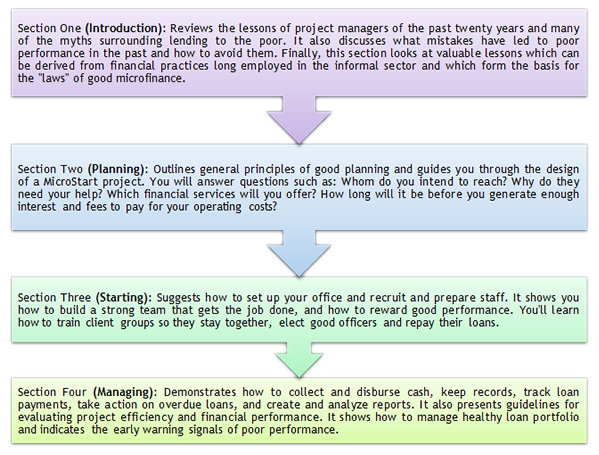
The module is divided into four sections and includes a tool kit. It begins with ground rules and best practices, then moves on to design and management of a successful project. Tool Kit contains copies of all forms discussed in the module, ranging from planning formats to recommended accounting documentation:
Book now for Human & Personal Development and Management Modules
Module Objectives
The goal of the MicroStart module is to create income and employment in poor communities through the development of local microenterprises and, in the process, increase the financial well-being of borrowers, their families, and the community at large. This module has been designed to help participating organizations to:
- Reach truly substantial numbers of rural and urban poor, especially women
- Provide a step-by-step approach to enterprise development starting with very small loans which allow a business to make productive investments quickly
- Produce impressive results in terms of generating new income, which borrowers typically invest in improved nutrition, better housing, education and health care
- Achieve a consistently high loan repayment rate of at least 95% and more typically, 98%
- Become a powerful tool to free the poor from high interest rates charged by professional money lenders.